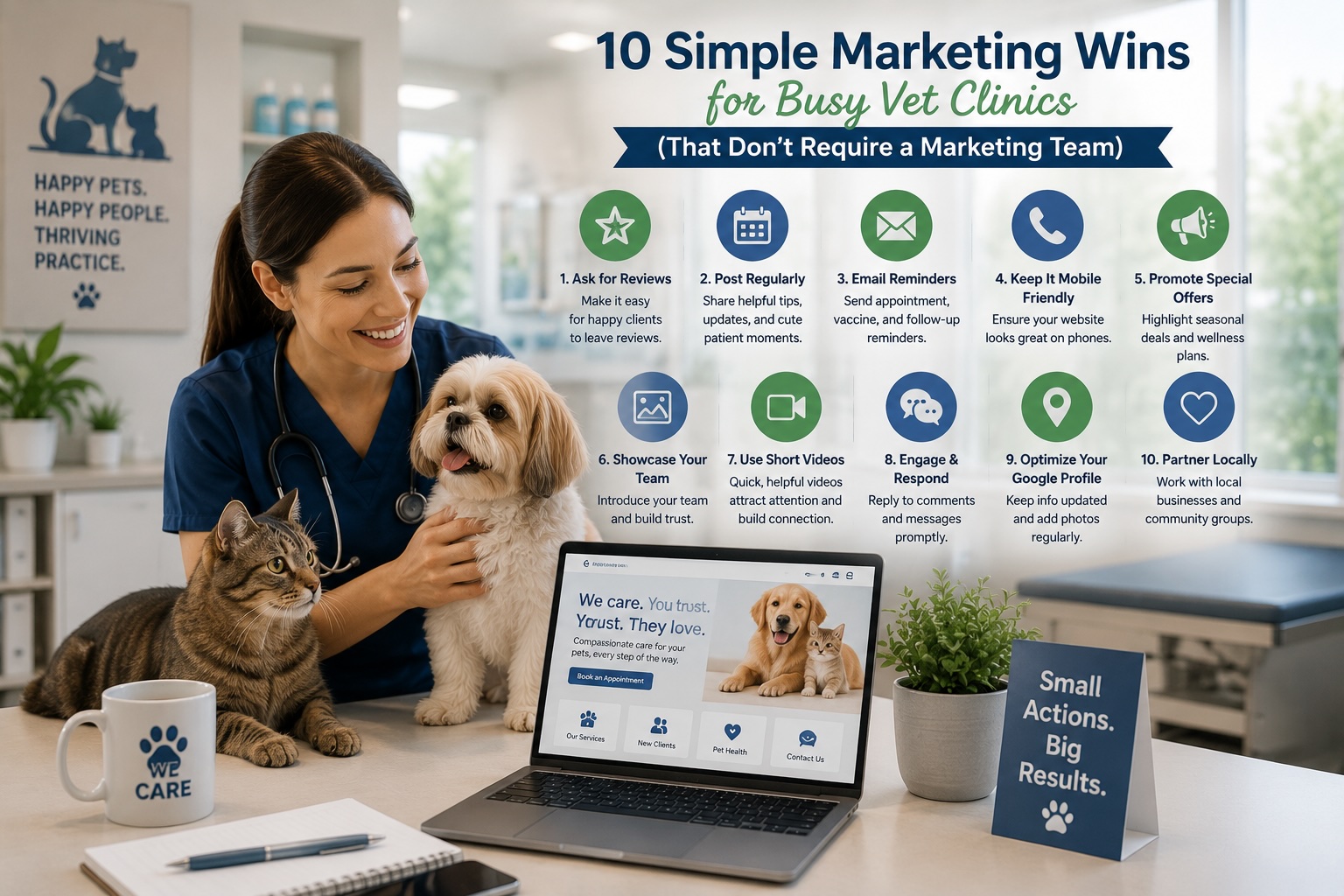
10 Simple Marketing Wins for Busy Vet Clinics (That Don’t Require a Marketing Team)
Discover 10 practical, low-effort marketing wins busy vet clinics can apply between appointments to attract new clients, boost reviews, and strengthen client loyalty.

If you run or manage a vet clinic, you already know: your actual job description has very little to do with what’s on paper.
You’re part medical professional, part therapist, part air-traffic controller… and somewhere way down the list, you’re also supposed to be “doing marketing.”
Most clinics I’ve worked with don’t lack care. They lack capacity. You don’t need a 40-page strategy deck; you need things that can be done between surgeries, callbacks, and the client who “just has a quick question” that somehow turns into a 20‑minute consult.
So that’s what this is: 10 marketing wins that are small enough to actually happen, but meaningful enough that you’ll feel them in your schedule and your revenue.
Are these the only things you could do? Of course not. But from what I’ve seen, when clinics get even three or four of these in place, their phones get a little busier, their clients get a little stickier, and their team stops rolling their eyes when someone mentions “marketing.”
And one more thing before we jump in: if you try any of this and it feels clunky at first, that’s normal. Good clinics iterate. You already do that with medicine—this is the same muscle, just pointed at communication instead of diagnostics.
Alright, coffee sip. Let’s get into it.
1. Make Your Google Business Profile Actually Useful
If you only touch one piece of marketing this month, make it your Google Business Profile.
Most pet owners don’t “research providers.” They type “vet near me” into their phone, glance at star ratings, skim a few photos, maybe read one review if you’re lucky. That’s it.
Quick wins you can knock out in under an hour:
Update hours, holiday closures, and emergency instructions
Add 10–15 real photos: lobby, exam rooms, team smiling with pets, parking lot sign
Write a short, human description: “We’re a small animal clinic in [town] that does a lot of dentistry and geriatric care. Same‑day sick appointments most days.”
I’ve noticed that clinics with current photos and clear hours get fewer angry calls about “I didn’t know you were closed” and more new clients who say, “You looked really friendly online.” Which do you want more of?
2. Turn Discharge Time into Review Time
You don’t need a fancy system to get more Google reviews. You need a repeatable habit.
Here’s the thing: the best time to ask for a review is right after you’ve done something genuinely helpful—pulled out the foxtail, solved the itching, survived the foreign body surgery with everyone intact.
Example script for the nurse or CSR, right at checkout:
“We’re so glad Bella is feeling better. Hey, quick favor—if you have a minute later today, could you leave us a Google review? It really helps other pet owners find us. I’ll text you the link.”
Then you (or your software) sends a simple text:
“Thanks for visiting [Clinic Name] today! If you’re happy with your care, would you mind leaving us a quick review? [direct link]”
I could be wrong but I’d bet something like 80% of clinics don’t attach the ask to a specific moment like this, so it just becomes “we should get more reviews someday.” You’re busy. Someday never shows up, but discharge appointments do.
3. One Helpful Email per Month (Not a Newsletter)
Most clinic “email newsletters” die after the second issue because they’re too much work. Don’t do a newsletter. Send one short, helpful email per month instead.
Pick a single topic and keep it tight:
February: “Heartworm myths we hear every week”
May: “What we actually recommend for flea/tick in our county”
October: “Anesthesia safety: what we do behind the scenes”
Keep it under 400 words. Use one photo from your clinic. Write like you talk.
Honestly, if all your email ever did was answer the five questions you get every single week at the front desk, your clients would be better informed than most. And better‑informed clients say “yes” more often, because they’re not trying to figure it out in a 5‑minute exam slot while their dog is climbing the walls.
4. A Website That Passes the Two-Second Test
I’ve sat with pet owners and watched them pull up clinic websites. You can see the micro‑expression when they land on something confusing: the tiny eye squint, the half‑second pause, then back to Google.
Your homepage doesn’t need to be beautiful. It needs to answer four questions in two seconds:
Where are you?
Are you taking new clients?
How do I contact you or book?
What do you especially do well?
That means:
Your phone number, address, and “New clients welcome / currently full” status visible without scrolling
A big, obvious “Request Appointment” or “Call Now” button
One short line like: “Small animal care with a focus on dentistry and seniors in [City].”
Actually, let me rephrase that: it’s less about design, more about reducing friction. If a stressed owner at 10 p.m. can figure out what to do next in one glance, you’re doing it right.

5. Social Media: Pick One Thing and Own It
Social media only turns into a monster when clinics try to be everywhere. You don’t need to be on every platform posting every day.
Pick:
One platform your clients actually use (often Facebook or Instagram)
One simple content type (e.g., “Pet of the Day,” “Behind the Scenes,” or “Two Tips Tuesday”)
Then set a 10‑minute rhythm:
Snap a photo of a cute patient (with permission)
Write one or two sentences: “Cooper came in today for his first puppy visit. Yes, we totally squealed.”
Post. Done.
From what I’ve seen, consistency beats cleverness. A slightly blurry but real photo of your tech cuddling a nervous cat will always do better than a polished stock image with perfect lighting.
And if social media truly drains you, that’s fine—delegate it to the team member who already takes 50 photos a day and loves it. Every clinic has one.
6. “We Miss You” Check‑Ins for Lapsed Patients
This one feels small but can quietly fill your schedule.
Run a list (or ask whoever handles your software) of pets who are:
18+ months since last visit
With overdue vaccines or overdue annual exam
Send a short, non‑guilty message—email or text:
“Hi [Name], we noticed we haven’t seen [Pet] in a while. If you’ve moved or found another clinic, no worries at all—just let us know so we can update our records. If you still consider us your vet, we’d love to see [Pet] for an overdue checkup. You can call us at [number] or request here: [link].”
Some will tell you they moved. That’s actually helpful. But many just… forgot. Life happened. This gives them a gentle way back without shame.
I’ve noticed that when clinics run this kind of reactivation once or twice a year, they pick up a surprising number of “Oh my gosh, thank you for the reminder” appointments. Why leave that on the table?
7. Teach Your Team a Simple Referral Line
Word of mouth is already your biggest driver, even if you don’t track it. You can nudge it a little without turning your staff into salespeople.
Try a casual, once‑a‑day sentence:
“We love clients like you. If your friends or family ever need a vet, we’re happy to help them too.”
That’s it. No cards, no discounts, no program (unless you want one). Just a human signal: “You’re our kind of client. More people like you would be great.”
But if you do like something tangible, keep it stupid‑simple:
A small stack of “New Client” cards at the desk
“Bring this card from a current client and get $20 off your first exam”
Current client gets $20 credit once the new one actually books
Say you’re a clinic like “Lakeside Animal Hospital” in a mid‑size town. If three clients a month actually act on that, over a year you’ve added 36 bonded clients for maybe a few hundred dollars in credits. That’s not a bad trade.
8. Make the Clinic Itself Do Some Marketing
Not everything has to happen online. Your physical space can carry a lot of weight if you’re intentional.
A few examples:
“Today We Helped With…” whiteboard in the lobby (dental cleaning, itchy skin, anxiety consult—no names, just types of visits)
Small, clear signs about services people don’t realize you offer: “Yes, we do behavior consults” or “Ask us about senior pain management”
A “Pet of the Month” wall with a printed photo and a few fun facts
Clients often sit in your lobby staring at their phones, mildly anxious. Give them something helpful to notice. If they realize during the wait, “Oh, you do dentals here?” you’ve planted a seed your reminders alone might not.
This is also where my slightly tangential point comes in: the feel of your waiting room matters more than fancy logos. A clean space, water bowl that’s actually full, staff that looks like they’ve slept in the last 24 hours—those things market you better than any brochure.
You know that feeling when you walk into a place and just sense they’re on top of things?
9. One Simple “House Rule” for Photos and Stories
Client stories are gold, but clinics get stuck on consent and process and then never use them.
Create one house rule:
At check‑in, your CSR asks: “Are you okay with us taking a quick photo of [Pet] for our social media or clinic materials if it comes up today?”
They tick yes/no in the software.
Now, every time you have a great moment—a new puppy visit, a senior pet turning 15, a dramatic but happy recovery—you know instantly whether you can snap a photo.
Later, with bodies out of crisis mode, you can share:
“This is Daisy. She came in last week for a nasty ear infection and is already feeling better. If your dog is shaking their head or you notice a smell, call us sooner rather than later.”
You’re not just posting a cute dog. You’re gently educating and normalizing care. That’s marketing that feels like medicine, not manipulation.
10. Track Three Numbers and Ignore the Rest (For Now)
Here’s my one slightly contrarian take: a lot of small clinics over‑complicate their metrics. Dashboards with 27 KPIs don’t make you a better doctor. They just make you tired.
Start with three:
New clients per month
Average number of visits per active patient per year
Percent of appointments coming from existing clients vs. new clients
You don’t need perfect accuracy on day one. A rough pull from your software once a month, written on a piece of paper taped in the break room, is fine.
Over time, when you try things—review asks, “We miss you” campaigns, better website—you’ll notice little shifts. “Huh, new clients ticked up in March. What did we change?” It encourages the team when they can see, in basic numbers, that the awkward stuff like asking for reviews is actually doing something.
And if you hate numbers, appoint one “numbers buddy” on your team who secretly enjoys this stuff and give them an extra coffee gift card now and then.
You don’t need to become a marketing expert to run a thriving clinic. You already have the hardest part nailed: you care about animals and the people attached to them.
Marketing, at this scale, is mostly about clearing the path so more of the right people can find you, trust you a little faster, and feel taken care of the whole way through.
Start with one of these that feels least annoying, try it for 60 days, and see what moves. Then adjust. Drop the ones that don’t fit your clinic’s style. Keep the ones that quietly work in the background while you do the job only you can do.
And if all you manage this month is updating your Google listing and asking for a couple of reviews at checkout? That’s still a win.