How Vet Clinics Can Earn More 5-Star Google Reviews Without Asking Awkwardly
How veterinary clinics can earn more 5-star Google reviews using better timing, simple systems, and small client-experience details—without incentives, pressure, or awkward asking.
If you run a clinic, you already know how this goes: someone types “vet near me,” stares at the stars, skims two or three recent comments, and either books or bails. It’s not a perfect proxy for medical quality, but it’s the currency people trade in with their thumbs. I’ve watched gentle, sharp clinicians lose to louder neighbors because the neighbors made reviews easy. Frustrating? Yep. Fixable? Absolutely.
Here’s the thing, you don’t need to grovel for praise or dangle gimmicks. Most pet parents actually want to say thanks when you get the tough stuff right—clear estimates, kind techs, a call that night to check on the post‑op pup. They just need a nudge that shows up at the right moment, in the right place, without making your front desk feel like telemarketers.
I read somewhere that something like 60% of first‑time pet owners pick the first clinic they see in the Google map pack. Could be 55, could be 70, but you get the point. That little cluster of stars is your sandwich board on the busiest street in town. If your last review is three months old or your top visible comment mentions a long wait, people second‑guess you fast. Do you blame them?
Look, you can’t control everything—there will always be a Monday at 4:30 p.m. when three emergencies land at once—but you can shape how often great experiences become public. And that’s where this gets fun, because it’s mostly workflow, not wizardry.
Why “begging” backfires (and how to avoid it) Begging feels needy, and clients pick up on that vibe right away. They’re juggling a nervous dachshund, a credit card, and a half‑remembered dosing schedule; the last thing they want is a guilt trip.
Swap begging for acknowledgment. “Thanks for trusting us with Pepper today. If this visit helped, a quick Google review really does help other pet parents find us.” That line isn’t a plea; it’s an invitation. Actually, let me rephrase that: it’s permission for them to thank your team in a way that helps someone else.
I’ve noticed that when teams have a short, natural script—and permission to skip it when the moment isn’t right—they ask more often and it doesn’t sound weird. Two lines, tops. No corporate fluff (you know what I mean).
Timing: text wins, but the window matters From what I’ve seen, the sweet spot is 45–120 minutes after checkout. The adrenaline has dropped, the pet’s home, and the relief is still warm. SMS beats email almost every time because it actually gets read. We’ve seen 3x, sometimes 5x, more reviews when the first touch is a simple text with a direct link to the review box instead of a pretty email that looks like a mini‑newsletter.
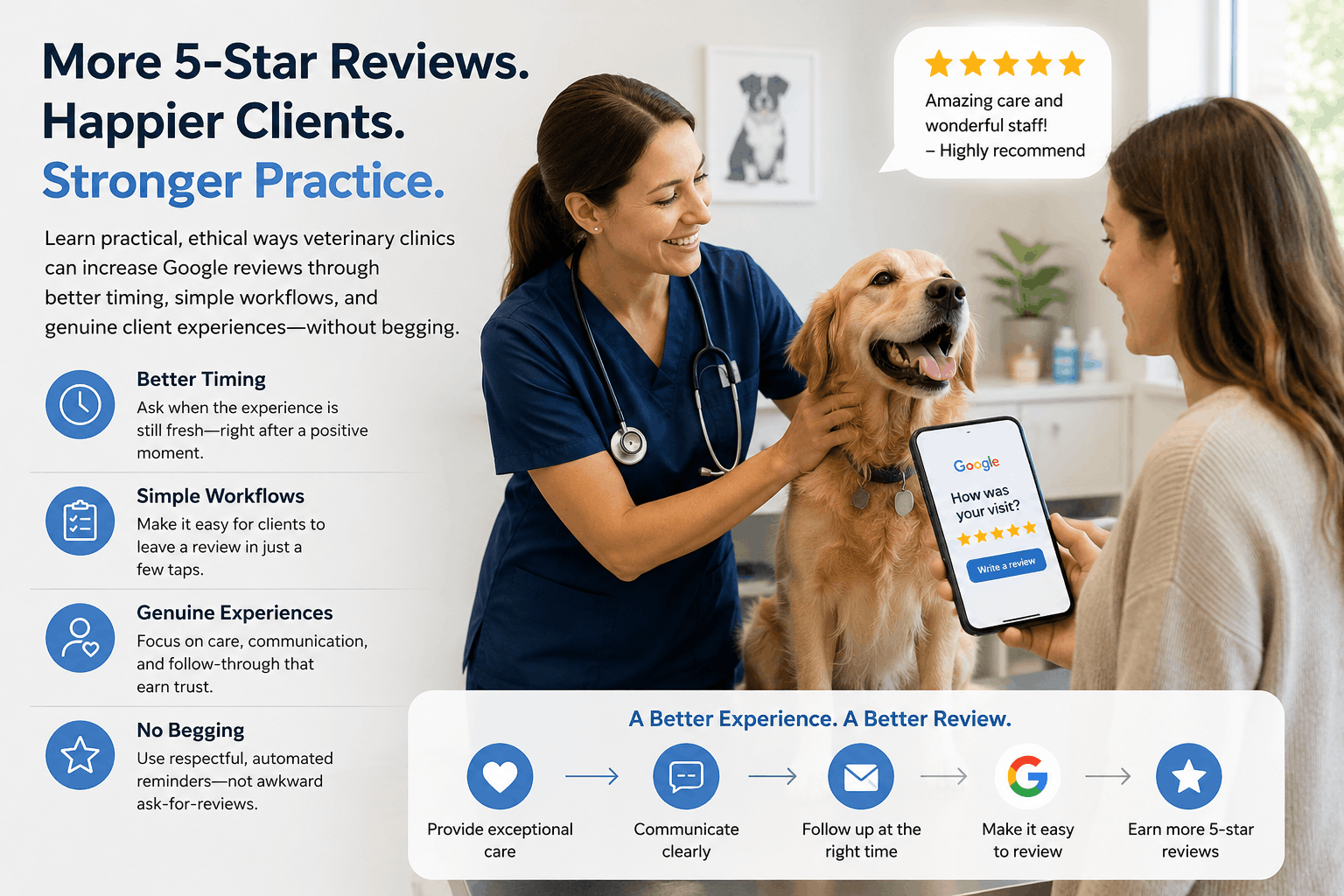
Sample flow that doesn’t feel pushy:
Visit completes at 10:14 a.m. in your PMS.
Your SaaS waits 60 minutes.
Text goes out: “Thanks for bringing Willow in today. If we took good care of you, would you share a quick Google review? [short link]”
If no click in 48 hours, send one (one!) friendly email reminder. Then stop.
And yes, use consent rules. Only message clients who opted in, and add “Reply STOP to opt out.” It’s polite and keeps your deliverability clean.
Direct link to the review box (don’t make them hunt) Send people straight to the pop‑up review form on your Google Business Profile, not the general listing. That means a proper Place ID link with the query parameter that opens the review composer on mobile. Your software should shorten it, tie it to the visit, and track whether it was tapped. If you’re still pasting a giant Google URL into emails, you’re making this harder than it needs to be.
No review gating, ever Inviting only “happy” clients is against Google’s guidelines, and honestly, it makes your profile brittle. A few “4 stars—kind team, slower checkout” comments make the whole page feel real. People trust a 4.8 more than a perfect 5.0 with five reviews from 2019. And if someone had a tough experience, send the same public invite plus a private feedback form that routes to an actual human who can call them back the same day.
Small, specific moments earn mentions You can’t fake five stars; you earn them in tiny ways clients love to talk about:
Snap a photo of the pet waking up from dental and text it with discharge instructions. Takes 15 seconds.
Put the pet’s name on the whiteboard facing the lobby. Parents light up when they see “MILO” in big letters.
Offer a two‑minute follow‑up call the next morning. “Any questions on the meds?” That call gets named in reviews constantly.
Keep a mini towel stack and some lint rollers by the door. Someone will need them.
I’ve noticed that clients don’t remember the invoice line items, but they remember how your tech knelt to meet their anxious shepherd at eye level. And that’s what they write about.
A quick detour about your front door (this comes back, promise) If the first ten feet of your clinic is chaos, your reviews will feel it. I’m talking squeaky hinges, a door that sticks, a crowded check‑in mat, and a “please wait here” sign taped at knee height. Spend an hour on what I call door choreography: oil the hinge, widen the mat, put a water bowl in a corner that doesn’t create a traffic knot, and add a hook at standing height for leashes. Toss a tiny bench near the entrance for cat carriers (off the floor). It sounds silly, but it lowers heart rates before a word is said, which makes everything you ask afterward—like a review—more likely to land. Why make a nervous moment harder than it has to be?
Train the ask into the rhythm, not as a speech The front desk isn’t a stage. The ask lives between “Do you want a printed receipt?” and “We’ll see you in three weeks.” Keep it conversational:
“If today felt helpful, would you mind telling Google? We read every one.”
“We share reviews with the team on Fridays—it keeps us improving.”
“Here’s a QR if it’s easier right now, but we’ll also text it in a bit.”
But if the client is teary after a tough conversation, skip it. The team should always have veto power without explaining themselves.
Incentives: do they work? Short answer: sort of, and not in the way you want. Coffee cards and raffles spike quantity, but the reviews get vague and they stop when the bribe stops. If you’re dead set on an incentive, tie it to community—“We’ll donate $1 per review this month to Paws & Co. Shelter”—and keep it low‑pressure. Personally, I’d rather recognize staff by name in your internal Slack when they’re mentioned. That turns reviews into fuel for culture.
Reply like a person on a Tuesday Two or three lines is usually enough. Use the pet’s name. Reference something real.
Positive: “Thanks, Jordan—Luna was a champ for her nail trim. We’ll have the cheese treats ready next time.”
Mixed: “I hear you on the wait, Maya. We’re adding a second tech in afternoons so rooms move faster. I’m glad Dr. Reyes answered your diet questions.”
Negative: “I’m sorry for how this felt, Tom. I left you a voicemail so we can talk through what happened. Here’s my direct line: [###].”
Don’t add medical specifics that weren’t in their comment. Keep PHI offline. And rotate who replies each day so it doesn’t become one person’s forever chore.
Make your SaaS do the heavy lifting If you’re building or using veterinary software (mine or anyone competent), aim for this:
Trigger on completed invoice or closed SOAP note, not appointment scheduled.
Delay 60–90 minutes; surgeries sometimes next morning.
SMS first, email second. Include first name, pet name, and doctor name.
Throttle to once every 90 days per client so frequent flyers aren’t spammed.
Segment euthanasias and end‑of‑life: no ask, just a condolence message and grief support link.
Sentiment alerts: replies with “upset,” “frustrated,” or “angry” escalate to a manager within 10 minutes.
A/B test two versions of your text for 30 days. Keep the winner, then test again later.
Dashboard: show last‑30‑day star average, reviews/week, and “staff mentions by name.”
Say you’re a clinic like Cedar Grove Vet in Boise. You connect Cornerstone, exclude “med pickup only,” and set the delay to 75 minutes. Week one, you get 9 reviews. Week four, you’re averaging 35 a month, and three techs are getting named regularly. Does that change the energy in your Monday huddle?
QR codes are still surprisingly useful A tiny, tasteful tent card at checkout—“Say something about your visit?”—with a QR that jumps straight to the review box can catch people while the moment is warm. Put one near the treat jar and another by the card reader. Don’t wallpaper the lobby. One clinic I worked with hung a screaming “REVIEW US!” poster and watched ratings stall; you could feel the pressure from the sidewalk.
Fix the friction behind so‑so stars Here’s the mild contrarian bit: review flow won’t save broken operations. If phones ring 12 times before pickup, if meds are always “ready in 20” but ready in 60, your review engine will sputter. Use the comments as a radar. Three mentions of “rushed” in a month? Nudge doctors to rework room pacing. “Confusing bill” shows up? Add a 45‑second estimate review at checkout with highlighters (yes, markers still work).
And don’t treat one bad review like a five‑alarm fire. Watch the pattern. If the pattern’s clean, keep going.
Privacy, boundaries, and tone Avoid sharing diagnoses or test results in public replies. Thank them, acknowledge the emotion, and move to a direct line. I could be wrong, but clinics that keep replies short and human see more second‑visit loyalty. People remember how you sounded.
Metrics that actually help Skip the lifetime total chest‑beating. Track:
Velocity: how many reviews did you earn this week?
Freshness: last‑30‑day average rating (not all‑time).
Balance: percent with comments longer than 12 words—those tend to rank higher.
Staff mentions: who’s getting named and for what?
Then do one tiny improvement per week. One. Adjust delay time, tweak the text, celebrate a tech by name, fix the sticky door. You’ll be amazed what six weeks does.
What to do with unfair or mistaken reviews It happens. Wrong clinic, wrong city, wrong pet. Reply once, calmly: “We don’t show a record for this visit, but I’d love to sort it out—here’s my direct line.” Flag if it violates guidelines, then move on. Fresh reviews bury weird ones.
A note on AI‑written replies You can smell the canned stuff instantly: “Your satisfaction is our priority.” It’s fine as a draft, but take 15 seconds to add a detail. “Peaches did great for her blood draw” lands differently than “your pet.” If you’re using our SaaS to draft, consider it a starting point, not the finish line.
The tiny systems that stack up
Use a branded short link: pawsvet.com/review or paws.vet/r. Easier to read, less scary to tap.
Put your Google link as a clickable button in digital invoices and portals.
Train one sentence for techs, one for CSRs, and let doctors pick their own.
Add the review link to the bottom of your post‑visit text—below the care instructions so it doesn’t hijack the message.
For surgeries, send the ask in the morning + a “How’s the appetite?” check that evening. The care check earns the review, not the other way around.
An oddly specific lobby tweak Play light music. I know, it sounds random. But dead‑silent lobbies amplify every cough, yip, and whispered credit‑card conversation. Soft, friendly music lowers the temperature just enough that people don’t stew. And calmer clients write kinder reviews. See how the detour loops back?
Scripts your team won’t hate
CSR: “If we took good care of Maple today, would you tell Google? We read them at our Friday huddle.”
Tech: “I’m going to text you your med tips and a link in about an hour—if anything helped today, a quick review helps nervous new pet parents.”
Doctor: “If you felt heard today, saying so on Google helps folks find us.”
But if the visit was rough, don’t ask. Your staff knows. Trust their read.
A quick reality check on numbers Don’t obsess over hitting 1,000 reviews by next quarter. A steady drip beats a firehose. If you’re at 0–100 total, a healthy target is 8–15 new reviews a month. If you’re at 300+, maybe 25–40. I’ve seen small two‑doctor clinics do more; I’ve seen bigger shops struggle. It depends on visit count, follow‑through, and whether your texts actually get delivered (carriers can be fussy).
Say you’re a clinic like Pine & Park Animal Care in Denver. You add a 75‑minute delay, switch to SMS first, and print one small QR card. You also fix the front door that used to slam. Four weeks later, you’re averaging 32 reviews a month, and the Google snippet shows “kind,” “thorough,” and “called to check” as top phrases. That’s not a vanity metric—that’s your brand writing itself in public.
What about asking in the room? If the vibe’s right, sure. A doctor wrapping up might say, “If this was helpful, you’ll get a text later with a review link—totally your call.” Light touch. No iPad thrust under noses. Room asks should feel like a handshake, not a sales pitch.
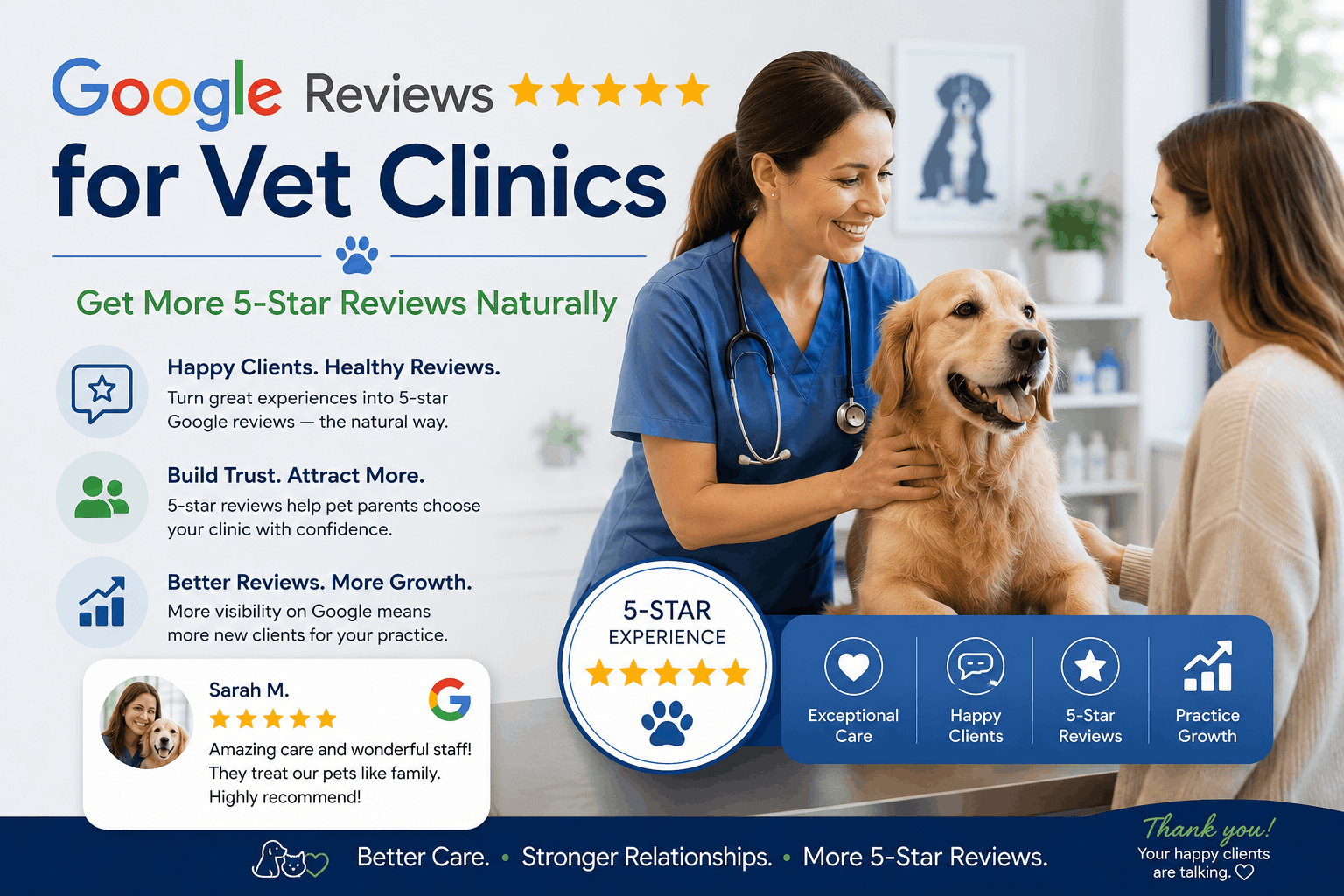
Your quick setup checklist (steal this)
Claim and verify your Google Business Profile. Add current hours, holiday hours, and five photos that look like your actual Tuesday.
Generate a direct “write a review” link; test it on iPhone and Android.
Create two SMS versions (under 20 words) and two email versions (under 60 words).
Turn on an automation: trigger on invoice/record close; delay 60–90 minutes.
Exclude euthanasia and med‑only pickups.
Throttle to once per client every 90 days.
Assign daily reply duty; track “mentions by name.”
Put one QR tent at checkout. Not three. One.
Fix anything at the front door that squeaks, sticks, or blocks traffic.
One more thing I’ve noticed: when the team hears their own names read out from reviews—“Shoutout to Tasha for three mentions this week”—the mood shifts. People stand a little taller. They clean the exam table without being asked. Culture compounds.
But don’t overcomplicate this. A clear ask, a well‑timed text, and a lobby that doesn’t make people sweat will move the needle more than a fancy campaign. Try it for two weeks. Watch the numbers, read the comments out loud, tweak one thing, then run it again. What’s the smallest change you can make today that a client might mention by name tomorrow?
And if you’re still wary about “bothering” people, send five texts a day for one week and see how many reply with something kind. My bet—earned the hard way, with plenty of trial and a few errors—is that more folks want to brag about your team than you think. Isn’t that a pretty good problem to have?