AI Scribes in Veterinary Practice: What They Speed Up and What Still Needs a Vet
AI scribes can speed up veterinary notes, but accuracy, privacy, language support and clinical responsibility still matter. Here’s what clinics should know before trusting AI-generated records daily.
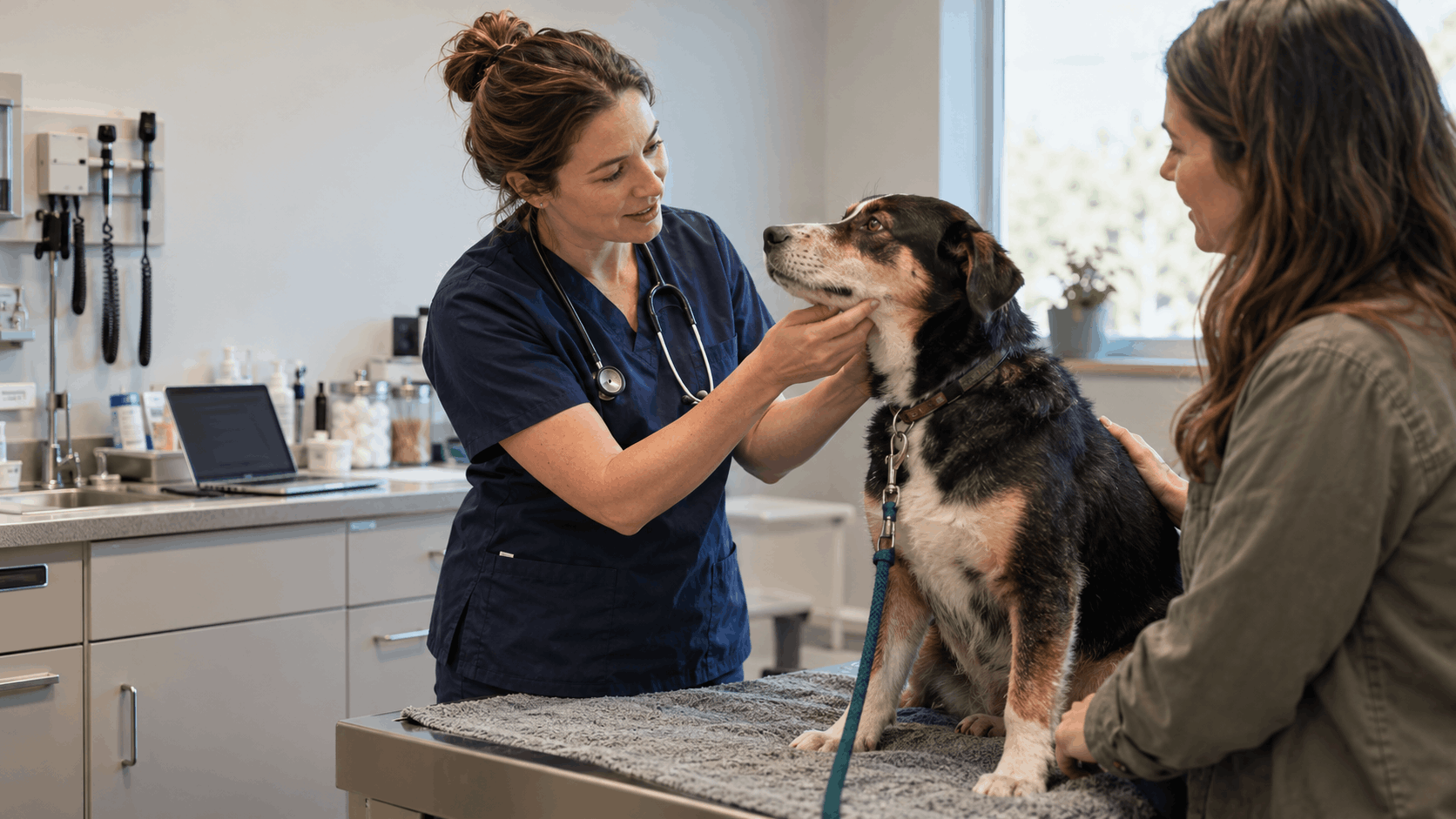
The least favorite part of a clinic day usually comes after the last appointment. The door closes and the half-finished notes are waiting: a cat with no weight recorded, a dog whose plan says "recheck 1 wk" and nothing else, two words left over from the owner's long account of three days of vomiting. What AI companies are selling to veterinary practices right now is, more or less, a promise to make that pile smaller.
Vets are paying attention. In a survey of several hundred veterinary professionals in the US by practice software company DaySmart, close to 58 percent named AI in clinic operations as the top trend in the industry. Around 44 percent of the same respondents said they were dealing with burnout.
Usage is climbing too. Instinct Science's general practice report, published in early 2026, found that roughly half of clinics use AI in some form, and close to two thirds of those use it mostly for medical records and exam notes. In a member poll by VIN, the Veterinary Information Network, use of AI scribes went from 3.5 percent to 17.5 percent in 14 months, between summer 2024 and fall 2025.
But the DaySmart survey has another number in it. Only about 13 percent of vets said AI had significantly reduced their admin work.
What these tools actually do
An AI scribe listens to the consultation, transcribes it and turns the transcript into a structured record, usually in SOAP format. Some run in the background for the whole appointment and build the note themselves. Others wait for the vet to dictate a short summary after the exam and then tidy it up. The background kind asks less of you. With dictation, you keep control of what goes in.
The market is shifting as well. Instinct Science, a cloud practice management vendor, bought ScribbleVet, one of the better-known scribe startups, in January 2026. Practice management systems are building note-taking in, while standalone scribes are adding phones, booking and reminders. For a clinic, the practical question is whether notes get generated in a separate app or inside the system where the patient record already lives. That's probably a bigger decision than which model sits underneath.
The accuracy problem
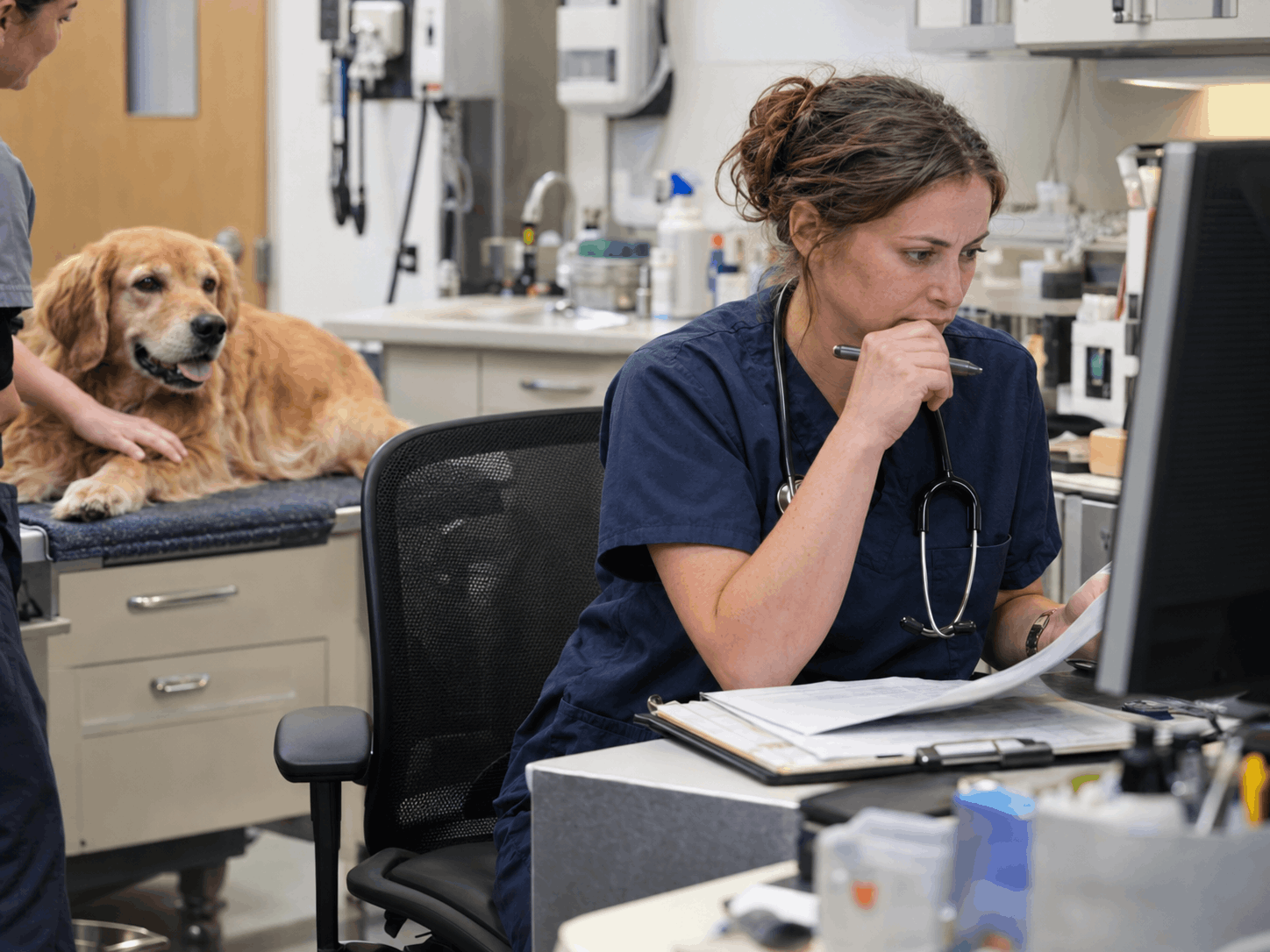
Most studies of scribe accuracy come from human medicine. I couldn't find an independent veterinary study of the same rigor. A 2025 study in npj Digital Medicine had clinicians mark AI-generated notes sentence by sentence and found fabricated information in about 1.5 percent of sentences and omissions in about 3.5 percent. Nearly half of the fabrications fell into the "major" category, meaning they could change a diagnosis or treatment. All of the authors worked for Tortus AI, which sells an AI scribe.
An audit posted as a preprint in August 2026 compared three commercial products on the same 142 consultations, this time counting errors per note rather than per sentence. Roughly a quarter of the notes, and by some standards a third, contained verified errors. One failure type the researchers highlighted will sound familiar to any vet. A treatment the clinician suggested and then decided against was written up as care that had been given. Picture a consult where you say you were going to start antibiotics, then decide to wait for the culture. Both statements are in the conversation, and the note shows antibiotics started.
A case from the NHS in England is similar. An MRI report read "null demyelination," meaning no sign of demyelination. The scribe dropped the word that reversed the meaning, and a negative result turned into a diagnosis. The patient caught it after asking about the result. The text read smoothly, and no clinician caught it.
Human-written notes aren't perfect either. Estimates cited in the CREOLA study put the average clinician-written note at a minimum of one error and four omissions. We can all guess how complete the fifteenth note of the day is when it's written from memory at closing time. But it does make you ask which kind of mistake is easier to catch. What a person forgets usually stays a blank field. An AI fills gaps with fluent sentences, and you have to actually read those sentences to see what went wrong.
AI can draft the note, but the vet signs off on the record and stays responsible for checking what's in it. The RCVS, the UK regulator, already says this in its advice on AI: AI-generated records should be verified manually and corrected at the time. In the US, record-keeping rules come from state boards, and the AVMA had not adopted a specific AI policy as of late 2025. Expecting "the software wrote that part" to get a vet off the hook in a complaint or a disciplinary process doesn't seem realistic. That probably isn't what some software companies want to hear, because "your note is ready, just approve it" is an easy line to sell.
Accents, noise and more than one language
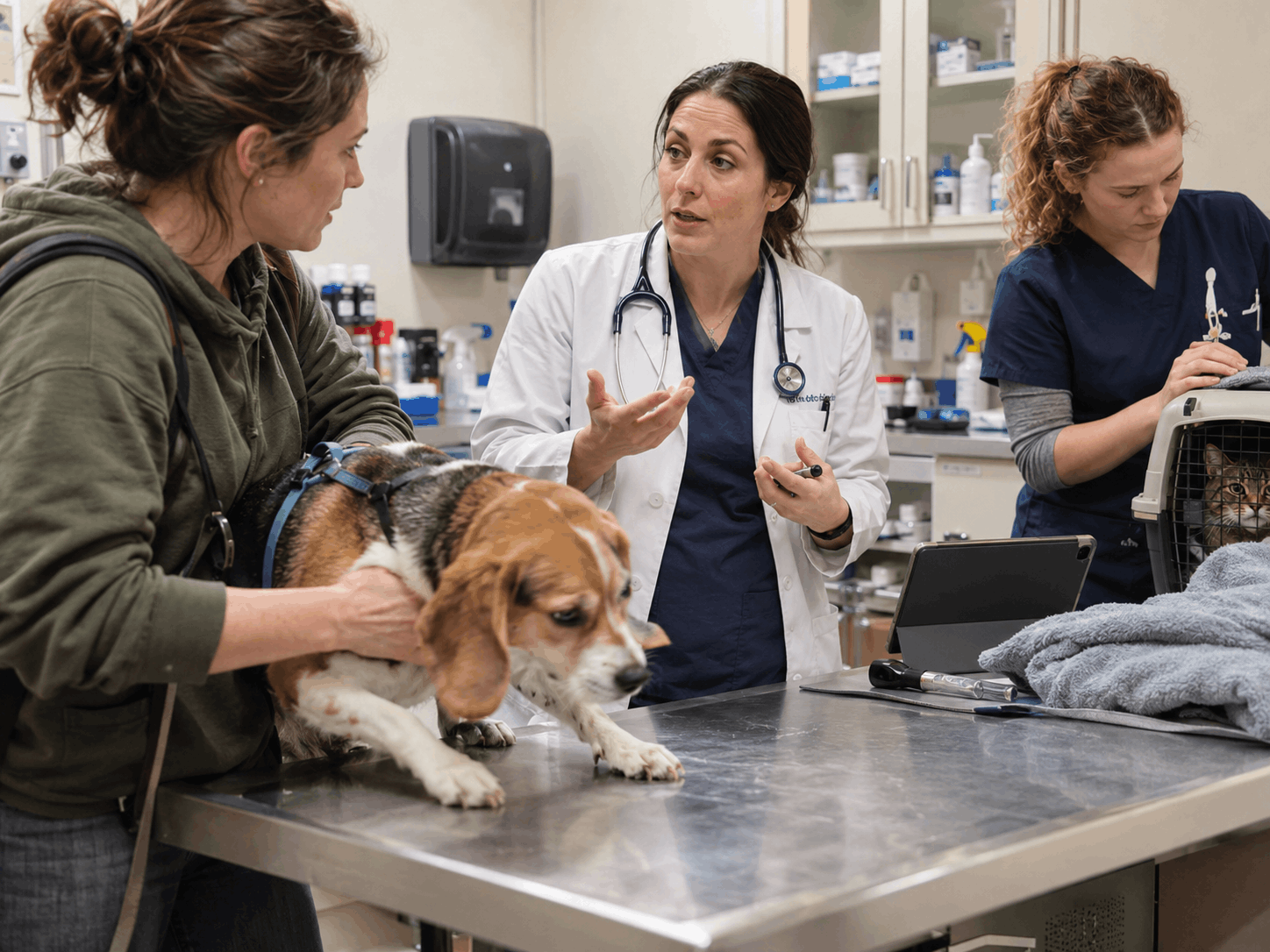
Most of these tools were built for English-speaking markets. In Dubai, Berlin or Riyadh a single consultation can switch between two languages, and plenty of English-speaking practices see a wide mix of accents every day.
Turkish, Finnish and Hungarian build words by stacking suffixes, so a single Turkish word like "kısırlaştırılamayacaklarından" carries what English needs a whole clause for. Older speech recognition systems worked from word lists and couldn't cope; a 2009 master's thesis at Istanbul Kültür University reported speaker-independent word accuracy of only 59 to 63 percent for continuous Turkish speech. Today's large models work with word fragments rather than whole words, which has narrowed the gap a lot.
Medical vocabulary is a separate test, and so is the room itself. Developers of an open research model fine-tuned for Turkish clinical dictation report clear gains on difficult medical terms, while warning that their figures come from synthetic data and that accents, background noise and overlapping speech will lower accuracy. A veterinary exam room has all of those conditions: a barking dog, two owners talking at once, Latin drug names in the middle of everyday speech. A product with a translated interface doesn't mean the underlying speech recognition model understands that language well. When you trial a tool, the vendor's clean demo recording tells you less than a noisy Tuesday afternoon in your own clinic.
Where the recording goes
The conversation in the exam room isn't only about the animal. The owner's name, voice, phone number and address go into that recording, and sometimes a money problem or a family situation too. In most places this blog is read, that makes the practice responsible for telling owners how the data is handled. How much work that involves depends on where you are.
In the UK it's UK GDPR and the ICO, and the RCVS puts it simply: being open with clients about how AI handles their data is the easiest way to stay out of trouble. It also suggests checking whether the developer can see practice data or use it to train the tool.
EU clinics using a US-based scribe are usually relying on the EU-US Data Privacy Framework. It still stands, but a July 2026 US Supreme Court ruling on removing FTC commissioners has privacy campaigners preparing a challenge, so it's worth keeping an eye on.
Australia's APP 8 asks for reasonable steps before personal information goes overseas, which in practice usually means an enforceable contract. If the recipient then mishandles it, section 16C can leave the practice accountable.
Saudi Arabia's PDPL wants a documented risk assessment before any transfer, and the data can only go to countries with adequate protection or under safeguards like standard contractual clauses. In the UAE, the first thing to check is whether you fall under the federal law or a free zone like DIFC or ADGM, which have their own rules.
Whatever the region, ask any vendor where the data is processed, how long recordings are kept and whether they're used to train the model, and get the answers in writing. And if anyone in the practice is pasting exam notes into a free chatbot to tidy them up, those questions probably never got asked at all.
When the owner knows they're being recorded
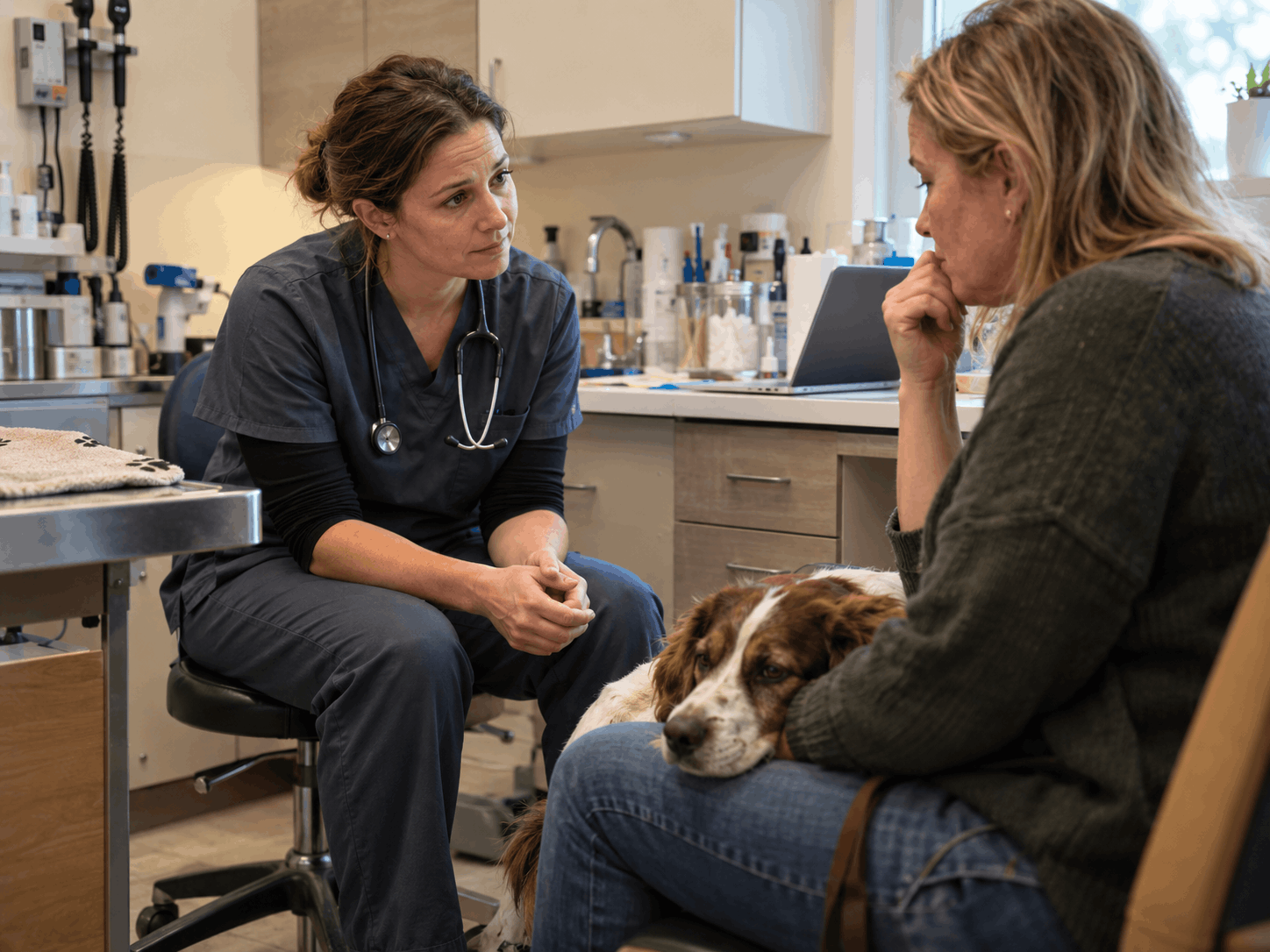
People talk differently when they know they're being recorded. The argument vendors make most often is that the vet can look up from the screen and at the person in the room. But in a vet clinic, the person across the table isn't the patient. It's the owner, someone who may be turning down a recommended test because they can't afford it, or hearing about euthanasia for the first time.
That person needs to be told the conversation is being recorded, and telling them changes the tone. Which effect is stronger, the owner being less open or the vet paying more attention to the animal, nobody knows right now. I haven't come across a study in veterinary medicine that measures it.
Where to start
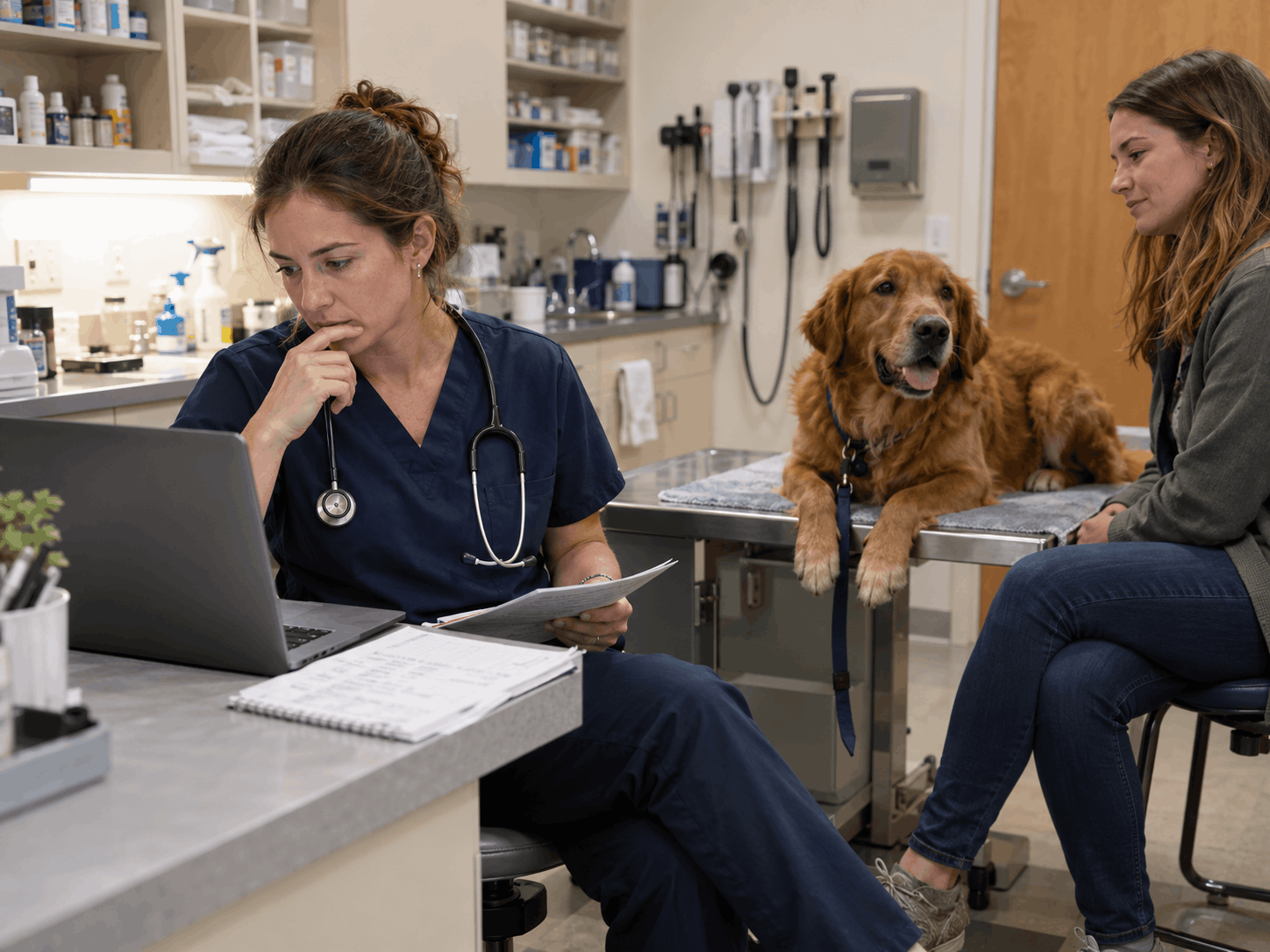
Start with the boring appointments. Vaccinations, rechecks, a nail trim that turns into a quick skin check: if the scribe gets one of those wrong, it costs you a few minutes of editing. Give it a couple of weeks there before you let it near a vomiting senior cat with three differentials and a plan that changed twice during the consult.
You won't read every line of every note with the same care, and nobody expects you to. Read the plan first, then drug names and doses, then allergies. After that, look for the small words that flip meaning: "no," "not detected," "decided against." Both cases above went wrong in exactly those spots.
Keep a rough tally for the first month. Nothing fancy; a tick on a sticky note every time you fix something in a note will do. The accuracy figure in the sales deck came from someone else's consults, not your accents, your caseload or your exam room. If the ticks thin out, the tool may be fitting your workflow better, or you may just have learned how to work with it. If they don't, a good chunk of the time you thought you were saving is going into corrections.
When we built voice-to-SOAP at Veterian, errors like these are why we chose to match drug names and doses against a verified drug database rather than leave them to the model's memory. The last reader of the note is still the vet.
This article is for general information only and is not legal, financial or investment advice. Data protection and record-keeping rules differ by country; check your own situation with a local adviser.
Sources
AI as the top industry trend (57.7%), burnout (43.8%), significant reduction in admin work (13.3%): DaySmart, 2026 Veterinary Industry Trends Report https://www.daysmart.com/vet/2026-industry-survey-results/
About 48% of general practices using AI, mainly for records and admin: Today's Veterinary Business, coverage of Instinct Science 2026 surveys (March 2026) https://todaysveterinarybusiness.com/?p=79151
63% of AI-adopting practices using it for medical records and SOAP notes; Instinct Science acquiring ScribbleVet (January 2026): Rework, Best AI Tools for Veterinary Clinics in 2026 (updated July 2026) https://resources.rework.com/tools/ai-tools/best-ai-tools-for-veterinary-clinics-2026
AI scribe use among VIN members rising from 3.5% to 17.5% (July 2024 to September 2025): ClinicShift newsletter https://clinicshift.beehiiv.com/p/48-of-vet-practices-are-now-using-ai-here-s-what-they-re-actually-doing-with-it
1.47% sentence-level hallucination rate, 3.45% omission rate, 44% of hallucinations rated major; estimate of at least 1 error and 4 omissions per clinician note: Asgari et al., CREOLA framework, npj Digital Medicine (2025) https://event.x-on.co.uk/hubfs/AVT/A%20framework%20to%20assess%20clinical%20safty%20and%20hallucination%20rates%20of%20LLMs%20for%20medical%20text%20summarisation_digital.pdf
Audit of three commercial scribes on 142 consultations; retracted treatment recorded as delivered care: One note in three, arXiv 2608.31017 (31 August 2026, preprint) https://huggingface.co/papers/2608.31017
"null demyelination" case: BERI, NHS AI scribes negation drop https://www.beri.net/article/nhs-ai-scribes-negation-drop-clinician-review-field-reconciliation
RCVS advice on AI: manual verification of AI-generated records, openness with clients, developer data access and training use: RCVS, Using artificial intelligence (AI) in practice https://www.rcvs.org.uk/veterinary-professionals/conduct-and-guidance/resources-and-updates/using-artificial-intelligence-ai-in-practice-advice-for-the-profession
AVMA task force on emerging technologies; no specific AI policy adopted as of November 2025: AVMA News, Building a framework for responsible AI in veterinary medicine (18 November 2025) https://www.avma.org/news/building-framework-responsible-ai-veterinary-medicine
Turkish continuous speech recognition, speaker-independent word accuracy 59-63%: Patlar, F., master's thesis, Istanbul Kültür University (2009) https://openaccess.iku.edu.tr/entities/publication/deca447f-bb89-443a-a1b7-855ec5db1d1a
Turkish medical speech recognition research model and its limitations: turkmedstt/whisper-large-v3-turkish-medical model card https://friendli.ai/models/turkmedstt/whisper-large-v3-turkish-medical
EU-US Data Privacy Framework still in force after Trump v. Slaughter; planned challenge: Computing (1 July 2026) https://www.computing.co.uk/news/2026/legislation-regulation/us-supreme-court-ruling-eu-us-data-privacy
APP 8 reasonable steps and section 16C accountability: OAIC, APP Guidelines Chapter 8 https://www.oaic.gov.au/privacy/australian-privacy-principles-guidelines/chapter-8-app-8-cross-border-disclosure-of-personal-information/
Saudi PDPL transfer rules (adequacy, standard contractual clauses, risk assessment): King & Spalding (17 November 2025) https://www.kslaw.com/insights/articles/international-personal-data-transfers-under-saudi-arabias-data-protection-law
UAE federal PDPL and separate free-zone regimes: Lawrbit (1 April 2024) https://www.lawrbit.com/article/personal-data-protection-law-in-saudi-arabia-and-united-arab-emirates/