Pet Travel Paperwork for Veterinary Practices: The 2026 Guide
A practical 2026 guide to pet travel paperwork for veterinary practices, covering EU pet passports, Animal Health Certificates, rabies rules, microchips and essential travel checks.

Consider a client who arrives on a Thursday afternoon with a Labrador, a ferry booking for Monday and a blue EU pet passport issued in France three years ago. The rabies vaccination is in date and the microchip scans. The problem is the owner rather than the dog. She lives in Kent, and since April an EU passport held by someone resident in Great Britain is no longer accepted for travel from Great Britain into the EU. She needs an Animal Health Certificate (AHC), it must be signed by an Official Veterinarian, and the practice's only OV is on leave until Monday.
Situations like this became more likely on 22 April 2026, when new EU rules on non-commercial pet movements started to apply. Many of them can be spotted when the client first phones.
This guide covers the pet travel documents vets are most often asked about in the UK, the EU, the US and Canada, the timing rules that most commonly invalidate them, and the questions reception staff can ask before a travel appointment is booked. It is a practical overview rather than legal advice. Rules change, and the destination's official guidance always takes precedence.
What changed on 22 April 2026
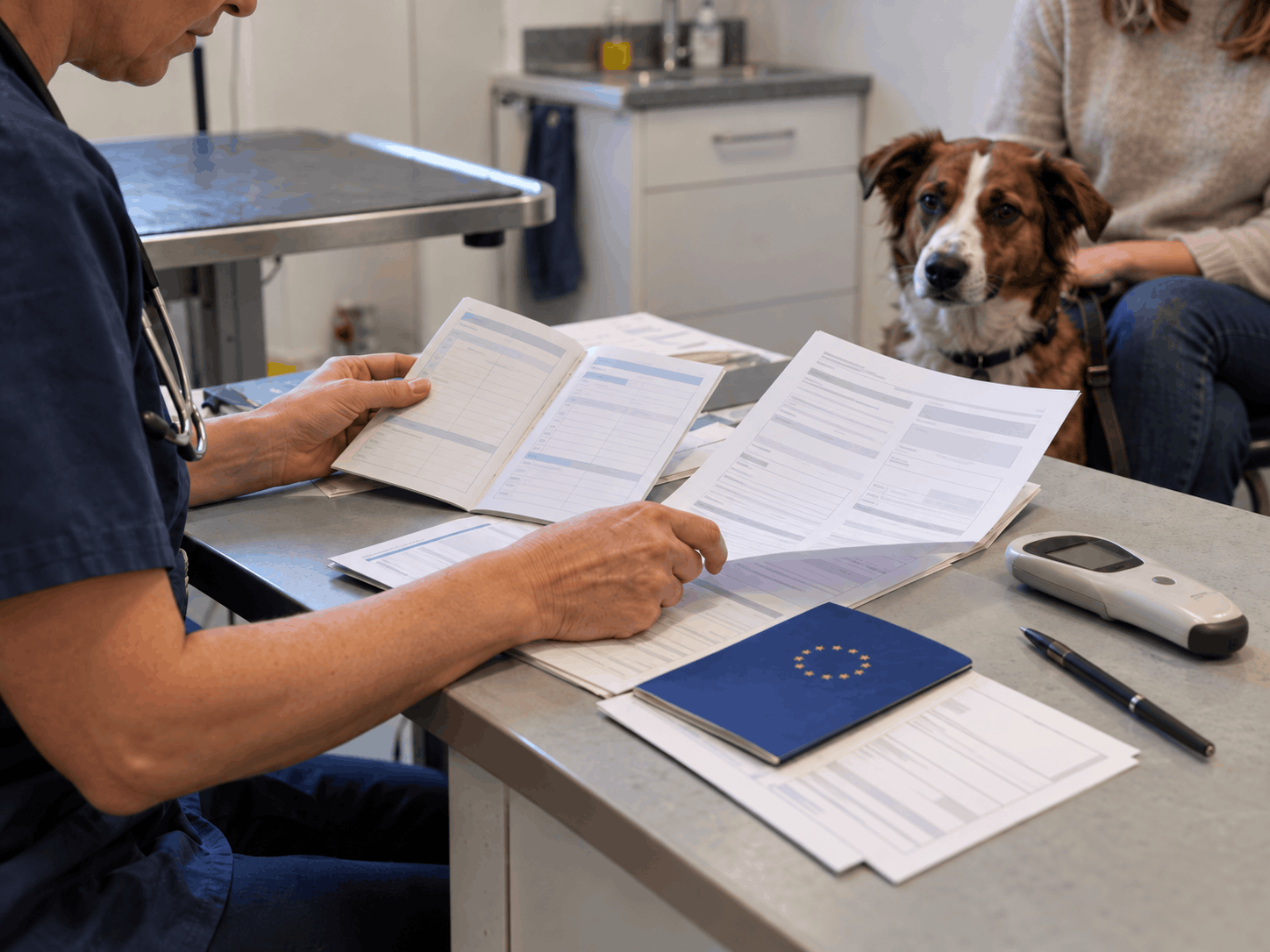
On 22 April 2026, Commission Delegated Regulation (EU) 2026/131 replaced the previous framework for non-commercial movements of dogs, cats and ferrets, Regulation (EU) No 576/2013. New model passports, certificates and declarations are set out in Implementing Regulation (EU) 2026/705. (EUR-Lex)
For UK practices, the most visible effect concerns passports. The European Commission states that an EU pet passport issued to an owner resident in Great Britain is no longer a valid document for travel from Great Britain to the EU. (European Commission) UK government guidance adds that this applies even if the passport was issued in an EU country, and that owners in England, Scotland and Wales who use one risk having their pet refused entry. They now need an AHC for each trip. Residents of Northern Ireland can still travel on an EU passport. (GOV.UK)
UK government guidance published the day before the change says EU passports may now only be issued to people whose main home is in the EU, and should not be used by holiday-home owners or seasonal visitors. GB residents can still use an EU passport for the return journey into Great Britain. (GOV.UK) Travel advisers also report that two familiar workarounds have closed: having an EU vet replace an AHC with an EU passport while abroad, and updating an existing passport with a non-EU address. (Wandering Bird) Owners who genuinely live in the EU are unaffected. Their passports remain usable for as long as the identification and rabies entries in them are valid.
Two other changes apply wherever the pet is coming from. A non-commercial movement is now limited to five dogs, cats or ferrets in a single vehicle, with exceptions for registered competitions and shows. And a pet can no longer travel unaccompanied as a non-commercial movement. If the owner can't travel with it, an authorised person must do so within five days of the owner's own journey, carrying a declaration signed by the owner that authorises them. The declaration follows an EU model, is attached to the passport or certificate, and must be written in English and an official language of the country of destination or entry. (European Commission, EUR-Lex, CFIA)
Existing documents were not invalidated overnight. Under Implementing Regulation (EU) 2026/705, an EU passport on the previous model is treated as compliant if it was issued before 1 January 2028, so member states can continue using existing stock until then. For pets entering from outside the EU, certificates on the previous model are treated as compliant until 31 March 2027, provided they were issued before 1 October 2026. These dates govern which document format is recognised, not how long an individual certificate lasts; each certificate must still be used within its normal validity period, such as 10 days from issue for entry into the EU. (EUR-Lex, Spanish Ministry of Agriculture)
The British Veterinary Association (BVA) warned when the rules took effect that UK practices should expect more work, because clients who had been travelling on EU passports now need a certificate for every trip. (Vet Times)
How strictly borders apply the residency rule is less clear. Early press coverage described enforcement as inconsistent, and some travel advisers say passport holders have been asked for proof of EU residence. Neither account is official guidance, and neither is a reason to issue paperwork on the assumption that it won't be checked. (The Portugal News, WorldCare Pet)
Which pet travel document applies
The document a pet needs depends mainly on where the owner lives and where they are going. For dogs entering the US, where the rabies vaccine was given can also change the requirements.
Document | Who it's for | Who issues it | Validity |
|---|---|---|---|
EU pet passport | Owners whose main residence is in an EU member state or Northern Ireland (GB residents may still use one to return to Great Britain) | An authorised vet in the EU or Northern Ireland | No fixed expiry; usable for travel while the microchip and rabies entries are valid |
UK Animal Health Certificate (AHC) | Owners resident in England, Scotland or Wales travelling to the EU | An Official Veterinarian (OV) | Entry into the EU within 10 days of issue, then up to 6 months for onward EU travel and return to Great Britain, ending earlier if the rabies vaccination expires |
US international health certificate | Owners travelling from the US | A USDA-accredited veterinarian, endorsed by APHIS | Set by the destination country |
Canadian certificate for the EU | Owners travelling from Canada to the EU | A licensed vet completes it; a CFIA vet endorses it before departure | 10 days from the vet's signature (5 days for Finland, Ireland, Malta and Northern Ireland) |
CDC Dog Import Form receipt | Dogs entering or returning to the US | The owner or importer, online | Up to 6 months for dogs that have only been in low-risk countries, unless the dog departs from a different country or visits a high-risk country |
One AHC can list up to five pets, but it covers a single trip. Every new journey from Great Britain to the EU needs a new certificate. (GOV.UK)
In the US, guidance from APHIS (the USDA's Animal and Plant Health Inspection Service) makes it the issuing veterinarian's responsibility to confirm that the pet meets every requirement of the destination country before issuing the certificate. Certificates are submitted for endorsement through VEHCS, the Veterinary Export Health Certification System. Depending on the destination, APHIS returns them digitally endorsed or ink-signed and embossed. (USDA APHIS, USDA APHIS)
Dogs coming back into the US need separate paperwork. Since 1 August 2024, a dog that has only been in rabies-free or low-risk countries during the previous six months needs a CDC (Centers for Disease Control and Prevention) Dog Import Form receipt, must be at least six months old, and must have a microchip that a universal scanner can read. Dogs that have been in a high-risk country face further requirements. The receipt can be reused for repeat trips, but a new form is needed if the dog departs from a different country. (CDC)
Canada moved to new EU certificates this year. The Canadian Food Inspection Agency (CFIA) says the new versions should be used now, and the previous versions are only accepted if signed on or before 30 September 2026. CFIA cannot endorse a certificate once the animal has left Canada. (CFIA)
Some journeys into the EU also need a rabies antibody titration test, a blood test carried out at an EU-approved laboratory. It is only required for pets coming from, or travelling through, countries that are not on the EU's lists. The UK, the US and Canada are all listed, so pets travelling directly from those countries don't need one. Where the test is required, the blood sample must be taken at least 30 days after the primary vaccination, or at any point during a valid, uninterrupted vaccination series, and at least 90 days before the certificate is issued, and the result must be at least 0.5 IU/ml. The test doesn't need repeating as long as later boosters are given on time. Transit through an unlisted country doesn't trigger the test if the pet stays inside the vehicle or within the perimeter of the port or international airport, and the owner or authorised person signs a declaration confirming this. (European Commission, EUR-Lex)
Great Britain has a similar rule for pets arriving from unlisted non-EU countries: a blood sample taken at least 30 days after vaccination, followed by a 3-month wait from the sample date before travel. (GOV.UK)
Each of these documents is covered in more detail in a separate article in this series.
Rabies vaccine and microchip timing
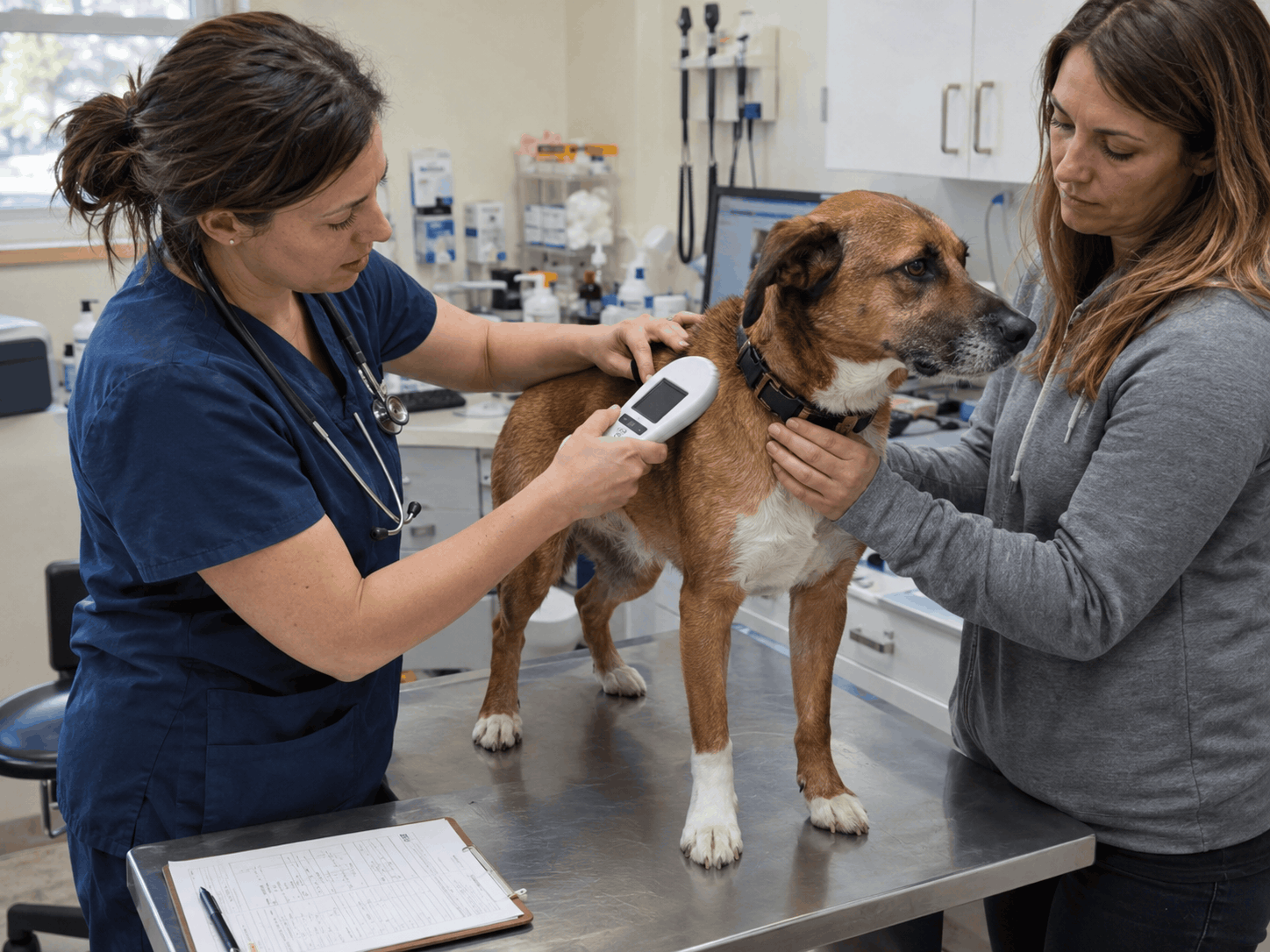
Many of the conditions that invalidate travel paperwork concern dates rather than clinical findings. The rules below are the EU's entry requirements, and they apply equally to pets travelling from the UK, the US and Canada. Other destinations set their own conditions. (European Commission)
The microchip comes first. The rabies vaccine must not be given before the microchip is implanted or read. A vaccine given before the chip doesn't count, and CFIA notes that every booster in that series is invalid as well. The pet needs a new primary vaccination.
The pet must be at least 12 weeks old on the day of vaccination.
A primary vaccination needs 21 days. Validity starts at least 21 days after the primary protocol is completed. In UK guidance, day 1 is the day after vaccination, and some vaccines take longer to become effective according to the manufacturer. (GOV.UK)
Boosters must not lapse. A booster given while the previous vaccination is still valid needs no waiting period. If cover lapses, even by a day, the next dose counts as a primary vaccination and the 21-day wait starts again. (CFIA)
Rabies validity must cover the return. If the vaccination expires while the pet is abroad, a UK AHC can no longer be used for onward travel within the EU or for re-entry to Great Britain. Compare the expiry date with the return date, not just the departure date. (GOV.UK)
Replacement microchips cause a related problem. CFIA guidance states that a pet fitted with a new microchip must be revaccinated, and that dose is treated as a primary vaccination with a fresh 21-day wait. Both chip numbers should appear on the vaccination record.
For reception staff, it helps to see the dates worked through. A dog has its first rabies vaccination on 3 March, and the vaccine used needs no more than the standard 21 days to take effect. Counting from 4 March, the earliest date an AHC can be issued is 25 March. Day 1 of the certificate's validity is the date of issue, so the dog must enter the EU by 3 April.
Tapeworm treatment for dogs

Dogs travelling to Finland, Ireland, Malta, Northern Ireland or Norway must be treated against the tapeworm Echinococcus multilocularis before arrival. Dogs entering Great Britain need a treatment every time, unless they are coming directly from one of those five countries. (GOV.UK, GOV.UK, European Commission)
The treatment has to be given by a vet no less than 24 hours and no more than 120 hours before the scheduled arrival. It must use an approved product containing praziquantel, or an equivalent shown to be effective against this parasite. The vet records the product name and manufacturer, the date and time of treatment, and their stamp and signature in the Echinococcus section of the certificate or passport.
Because the window is counted in hours, the time of treatment matters as much as the date. A dog treated at 4 pm on Monday can't arrive before 4 pm on Tuesday and must arrive before 4 pm on Saturday. For trips of five days or less from Great Britain, the dog can be treated before it leaves, provided it returns within the same 24 to 120 hour window. If the journey is delayed beyond 120 hours, the dog may need a new treatment abroad. (GOV.UK)
The deadline is tighter for Canadian travellers. A Canadian certificate for these countries is valid for only five days, and the treatment must be given before the licensed vet signs it. (CFIA)
Who can sign travel documents
Travel paperwork usually needs a vet with a specific government authorisation, and sometimes an additional official endorsement. If the right person isn't available, the appointment can't go ahead, however complete the records are.
UK: an AHC must be signed by an Official Veterinarian. Not every practice has one. (GOV.UK)
EU: passports are issued by authorised vets. Certificates for pets entering from outside the EU are issued by an official or authorised vet and then endorsed by the competent authority. (European Commission)
US: a USDA-accredited veterinarian issues the certificate and APHIS endorses it. (USDA APHIS)
Canada: a licensed vet completes the certificate and a CFIA vet endorses it before the animal leaves the country. (CFIA)
For practice managers, this makes travel work partly a scheduling problem. Appointments have to be booked with the right clinician, within a date window most clients don't fully understand, and often close to departure. Checking the authorised vet's availability well before school holidays and other busy travel periods can prevent last-minute cancellations.
Front-desk checklist before booking a travel appointment

Much of what the vet needs can be collected when the client first calls.
When the client first calls
Where does the owner live? This usually determines which document applies.
Will the owner travel with the pet? If not, will an authorised person travel within five days of the owner's own journey, carrying a written authorisation signed by the owner?
Which country are they travelling to, and will they pass through any others?
Where has the pet been in the last six months? This matters for dogs entering the US.
What are the departure and return dates?
How many pets are travelling, and in the same vehicle?
Checking the record
Is a microchip recorded, with a readable number and an implant date? Has the pet ever been re-chipped?
Was the microchip implanted before, or on the same day as, the rabies vaccination?
Was the pet at least 12 weeks old when vaccinated?
If this is a primary vaccination, will the waiting period have passed by the appointment date?
Will the rabies vaccination still be valid on the return date?
Has the pet been in, or will it pass through, a country that triggers a rabies antibody blood test? If so, is there time for the 90-day (EU) or 3-month (Great Britain) wait?
Does the destination, or the return journey, require tapeworm treatment for a dog?
Booking the appointment
Is it booked with an authorised vet (an OV in the UK, a USDA-accredited vet in the US)?
Does the date fall within the issuing window, such as 10 days before EU entry for an AHC?
Has the client been asked to bring previous vaccination records and any existing passport?
Does the destination add its own requirements on top of EU rules? Malta, for example, requires advance notification.
What does the return journey need, such as tapeworm treatment before re-entering Great Britain or a CDC Dog Import Form for the US?
Toward digital certificates
Parts of the process are already digital. In the US, accredited vets can issue certificates electronically through VEHCS, and for some destinations APHIS endorses them digitally. (USDA APHIS) Electronic pet passports have also been discussed in the EU, although no timetable has been confirmed. (WorldCare Pet)
Digital formats won't fix poor source data. A microchip number entered incorrectly in the practice record will be reproduced on every certificate generated from it. Clean, structured records of microchips, vaccinations, batch numbers and treatments make any future format easier to adopt.
How Veterian can help
Travel certificates are only as reliable as the clinical records behind them. In Veterian, each pet's vaccination history sits in the patient profile, with the vaccine type, the date given and the next due date on one screen, alongside the rest of the medical record.
Vaccine records can be linked to stock, so the expiry date and batch or serial number are captured when the vaccine is given and are ready when a certificate is being completed. Lists of upcoming and overdue vaccines make it easier to spot a rabies booster that would lapse before a client's next trip. Reminders can go out by SMS, WhatsApp, email or push notification through the Veterian Pet app, and vaccine types and repeat intervals can be set up per species to match your clinic's protocols.
Veterian doesn't decide which document a pet needs, issue official certificates or confirm travel eligibility. Those decisions stay with the authorised vet. What it can do is keep the dates and numbers that vet relies on complete and in one place. If you'd like to see how this works in your clinic, you can try Veterian free for 14 days.
More in this series (link once published):
Animal Health Certificates: A Practical Guide for UK Vet Practices
How UK Vet Practices Can Handle the Rise in AHC Appointments
EU Pet Passports in 2026: What Veterinary Clinics Must Check Before Issuing
Pet Travel Certificates for US and Canadian Vet Practices: USDA, CDC and CFIA Rules in 2026
Sources
Bringing a pet into the EU from a non-EU country – European Commission: https://food.ec.europa.eu/animals/live-animal-movements/dogs-cats-and-ferrets/bringing-pet-eu-non-eu-country_en
Listing of territories and non-EU countries – European Commission: https://food.ec.europa.eu/animals/live-animal-movements/dogs-cats-and-ferrets/listing-territories-and-non-eu-countries_en
Commission Delegated Regulation (EU) 2026/131 – EUR-Lex: https://eur-lex.europa.eu/eli/reg_del/2026/131/oj
Commission Implementing Regulation (EU) 2026/705 – EUR-Lex: https://eur-lex.europa.eu/eli/reg_impl/2026/705/oj
Entry into Spain of dogs, cats and ferrets from other Member States – Spanish Ministry of Agriculture, Fisheries and Food: https://servicio.mapa.gob.es/es/dam/jcr:e35fbe22-9efd-42d4-b9b3-48c45f95d697/introenespperrosgatoshuronesdeotroseemm.pdf
New EU rules for pet travel for GB residents – GOV.UK: https://www.gov.uk/government/news/new-eu-rules-for-pet-travel-for-gb-residents
Taking your pet dog, cat or ferret abroad – GOV.UK: https://www.gov.uk/taking-your-pet-abroad
Getting an animal health certificate – GOV.UK: https://www.gov.uk/taking-your-pet-abroad/getting-an-animal-health-certificate
Tapeworm treatment for dogs (travelling abroad) – GOV.UK: https://www.gov.uk/taking-your-pet-abroad/tapeworm-treatment-for-dogs
Tapeworm treatment for dogs (entering Great Britain) – GOV.UK: https://www.gov.uk/bring-pet-to-great-britain/tapeworm-treatment-dogs
Blood tests for rabies (entering Great Britain) – GOV.UK: https://www.gov.uk/bring-pet-to-great-britain/rabies-blood-tests
Entry Requirements for Dogs from Dog-Rabies Free or Low-Risk Countries – CDC: https://www.cdc.gov/importation/dogs/rabies-free-low-risk-countries.html
Export of dogs, cats and ferrets to the European Union or Northern Ireland: Non-commercial movements – CFIA: https://inspection.canada.ca/en/animal-health/terrestrial-animals/exports/pets/eu-non-commercial
Pet Travel From the United States to Mongolia – USDA APHIS: https://www.aphis.usda.gov/pet-travel/pet-travel-united-states-mongolia
Pet Travel From the United States to Bahrain – USDA APHIS: https://www.aphis.usda.gov/es/node/8215
BVA issues workload warning over EU pet travel rule change – Vet Times: https://www.vettimes.com/news/business/practice-developments/bva-issues-workload-warning-over-eu-pet-travel-rule-change
EU Pet Passport Changes (2026) – Wandering Bird: https://www.wandering-bird.com/eu-pet-passport-changes-2026/
EU Pet Passport Rules Have Changed – WorldCare Pet: https://worldcarepet.com/2026/06/16/eu-pet-passport-rules-changes-2026/
New EU rules for travelling with animals – The Portugal News: https://www.theportugalnews.com/news/2026-04-22/new-european-union-rules-for-traveling-with-animals-come-into-force/1011317